March 29, 2026
An Opening Weekend Rabbit Hole
Happy opening weekend of baseball.
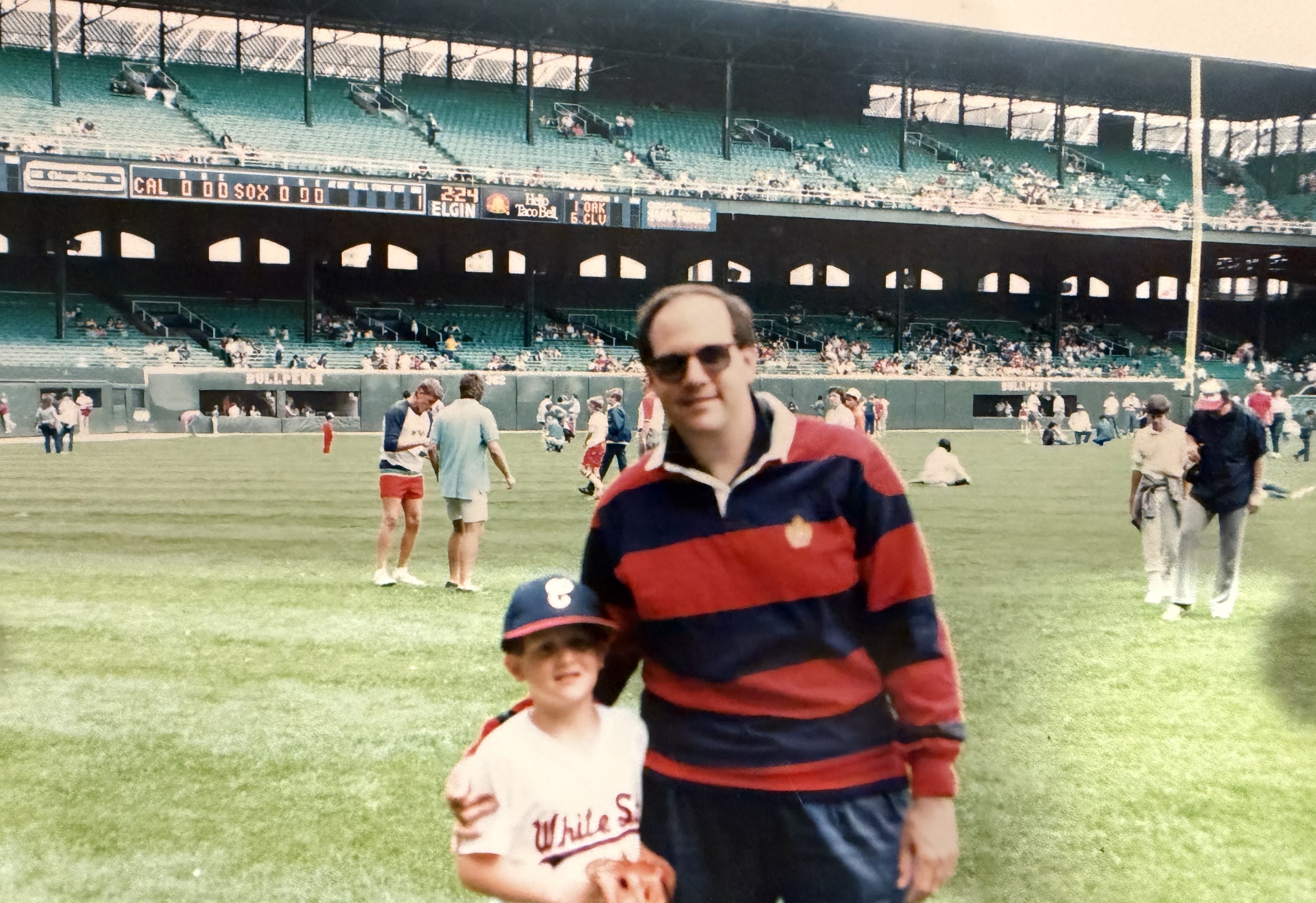
Last night, I was watching the Dodgers and the Diamondbacks when I found myself staring at a photo on a shelf near the TV in our family room. It sits among a cluster of family pictures, nothing particularly prominent about its placement, but it's one I always like looking at. It's a snapshot of me and my dad at Old Comiskey Park. This must have been some kind of special event day where families could go out to the field.
I do remember walking around the outfield taking in how big the stadium felt from that perspective. We also got a chance to put that glove you see to use and play some catch.
One memory stands out: while we were playing catch, “Tequila” started playing over the PA. If you know your Pee-wee Herman, you know exactly why that matters. My dad and I both loved “Pee-wee’s Big Adventure,” and I have a distinct memory of looking over to see him doing the hands-forward, hands-back bar dance from the movie. In complete earnestness.
That’s pretty much where my specific memories of the day end. But maybe that’s exactly what makes the photo so compelling to me. When you don’t have a lot of context, the image has to do more of the work.
I found myself studying it last night the way you might study an old painting, trying to extract every piece of information from the frame. And a few things started to surface.
The first one genuinely surprised me, because it’s something I’d never considered before. My dad loved taking photos his whole life, with a big camera draped over his shoulder when I was young, later on his iPhone. But I honestly cannot remember a single time he stopped a stranger and asked them to take a photo of the two of us. I’m sure it happened. I just can’t place it.
As far as I can remember, it was just the two of us at that game. Which means at some point, out on that field, he tapped someone on the shoulder and asked them to capture the moment. That’s not nothing. It tells me he recognized the afternoon was something worth preserving. My dad wasn’t really overly sentimental, at least not until later in his life, so this little piece of information resonated.
You can also tell that the stranger wasn’t exactly a skilled photographer, or perhaps just not careful. The focus is soft. It might have been rushed. But the moment is there, and I’m grateful for it.
Something else surfaced as I kept looking.
We take it completely for granted now that every photo we capture is packed with metadata: exact time, precise location, device information. All of it stored invisibly and instantly. There was a more primitive version of this that many of us remember, where you could set a camera to brand a garish timestamp directly onto the image. I always hated that look. But in this moment, I found myself wishing I had it.
I pulled the photo out of the frame and examined both sides. The back had a faint serial number, probably a ghost from a one-hour photo lab. Nothing else.
I mean, it didn’t really matter if I knew when the photo was taken; it had no impact on my enjoyment of it, but once the question was in my brain, it was hard to get rid of it. The curiosity spiraled in on itself, and I found myself wanting to do what I could to determine the exact day and game when this was taken.
Looking at my younger self I could eyeball that I was probably within a range of six to maybe eight, but it’s definitely hard to tell.
And I’m certainly rocking that mid-80s White Sox red and white look, but that only broadly helps us within the decade.
As I was about to give up and get back to watching baseball, I looked closer at the photo. The stranger who took this photo had the focus backwards. Our faces are soft, but the background is sharp. And the background, it turns out, is full of information.
Three things are clearly readable:
- The matchup: the California Angels were in town to play the White Sox. A small bit of poetry there, given that California is now my home, even if the Angels are not my team.
- The time: 2:24 p.m.
- What appears to be an out-of-town American League scoreboard, showing a game between Oakland and Cleveland.
Was this enough to work with? There was no turning back.
I told myself I’d spend 30 minutes on it.
The three data points in the background of that photo were really all I had: the matchup, the time, and that out-of-town scoreboard showing Oakland and Cleveland. If I could cross-reference those against historical records, I thought, maybe I could figure out exactly when this was taken.
My first stop was the MLB Stats API, which has free historical schedule data going pretty far back in time. A call per season with a date range got me every California Angels road game at Comiskey Park from 1980 through 1989. I looped through those and added them to my dataset. Here’s an example:
curl -s "https://statsapi.mlb.com/api/v1/schedule?sportId=1&date=1987-06-27&hydrate=team"67 candidate games across the decade.
From there, I cross-referenced each date against the Cleveland schedule. The out-of-town scoreboard shows Oakland at Cleveland, so I needed days when both series were happening simultaneously. I iterated through 63 individual HTTP requests, one per date (a few dates had doubleheaders):
curl -s "https://statsapi.mlb.com/api/v1/schedule?sportId=1&date=1987-06-27&teamId=114&opponentId=133"That cut the list to 23 games, all falling between 1984 and 1987.
Next: day games only. The photo was clearly taken during the day, clock reading 2:24 p.m. The API carries a dayNight field on every game entry, so I ran a filter.
Down to five. One of those was a Wednesday, which didn’t feel right for what was clearly a family outing. That left four weekend candidates: two in September and two in late June 1987, back-to-back days in the same series.
At this point, it already felt like great progress to confidently narrow a decade down to four possible dates. But I wanted to push further, and the scoreboard offered one more thread to pull.
The numbers on the out-of-town board next to Oakland and Cleveland look like a “6” and a “1.” If I could match those to a score — final or in-progress — on any of the four candidate dates, I might be able to pick the right one. I figured I’d start with MLB API’s boxscore endpoint.
To be safe, I also checked Retrosheet, which has been archiving inning-by-inning box scores for every game since the 19th century. Thankfully the URLs follow a clean, predictable pattern:
https://www.retrosheet.org/boxesetc/1984/B09080CLE1984.htm  -- OAK at CLE, Sep 8 '84
https://www.retrosheet.org/boxesetc/1986/B09140CLE1986.htm  -- OAK at CLE, Sep 14 '86
https://www.retrosheet.org/boxesetc/1987/B06270CLE1987.htm  -- OAK at CLE, Jun 27 '87
https://www.retrosheet.org/boxesetc/1987/B06280CLE1987.htm  -- OAK at CLE, Jun 28 '87
I pulled the inning-by-inning scoring for each Oakland-Cleveland game and computed every running score after each half-inning — not just the finals, but every intermediate state the scoreboard could have shown.
September 8, 1984: Oakland beat Cleveland 9–5. At no point during the game was the score ever 6–1 in either direction.
September 14, 1986: Cleveland won 5–2. Same story — no 6–1 combination at any point.
June 28, 1987: Oakland shut out Cleveland 10–0. Never close to 6–1:
Inning:  1  2  3  4  5  6  7  8  9
OAK:     0  1  0  1  0  0  2  5  1
CLE:     0  0  0  0  0  0  0  0  0
Running: 0-0  1-0  1-0  2-0 ...
But June 27, 1987 told a different story:
Inning:  1  2  3  4  5  6  7  8  9
OAK:     2  0  4  1  1  0  2  0  3
CLE:     0  1  0  0  2  0  0  0  0
Running: 2-0  2-1  6-1  7-1  8-3 ...
After the top of the third: Oakland 6, Cleveland 1. A game starting around 1:35 p.m. Eastern would be right in that window at 3:24 (an hour ahead of the 2:24 showing on the Chicago clock). Of the four candidate dates, this was the only one where the Oakland-Cleveland game ever passed through a 6-1 score.
Now, maddeningly, the numbers on the actual scoreboard in the photo appear reversed — “1” next to Oakland and “6” next to Cleveland. But these old out-of-town scoreboards were manually operated and the idea of a number being placed in the wrong row during an update isn’t hard to imagine.
I then noticed what looks like the letter “P” above what I assumed were scores. Pitchers maybe? I took a look at Baseball Almanac to see if those might be pitcher uniform numbers:
https://www.baseball-almanac.com/teamstats/roster.php?y=1987&t=OAK
https://www.baseball-almanac.com/teamstats/roster.php?y=1987&t=CLE- Oakland: No pitcher wore #1. The lowest number among pitchers was 12 (Rick Rodriguez).
- Cleveland: No pitcher wore #6. That number belonged to catcher Andy Allanson.
So the “P” remains a mystery for now, if I’m even reading it right.
Sticking with the concept of scoreboard irregularities, I also considered the admittedly outside possibility that the photo was snapped right in a moment when the lights of the out-of-town scoreboard were transitioning.
So I ran one final check: the full MLB slate for June 27 and 28, looking for any game anywhere that ended 6-1:
curl -s "https://statsapi.mlb.com/api/v1/schedule?sportId=1&date=1987-06-27&hydrate=team"No 6-1 final anywhere on either day. The numbers on the scoreboard weren’t a final score, they had to be a snapshot of a game in progress. And only one of my four candidates produced that snapshot.
So I concluded, after what was definitely more than 30 minutes, that the photo was taken on Saturday, June 27, 1987.
I was seven years old.
California Angels 3, Chicago White Sox 1 at Old Comiskey Park.
A day game, a summer weekend.
Mike Witt started for the Angels; Floyd Bannister for the Sox.
And, in case this interests you, over in Cleveland that same afternoon, a 23-year-old Mark McGwire hit three home runs.
By the end of the investigation, I’d made roughly 95 API calls and spent the better part of an evening on it. I didn’t achieve the pinpoint accuracy I set out to, but it was a lot of fun immersing myself in the information from that moment in history and spending more time with this photo than I have before.
A big win all around.
✌️❤️⚾️📊